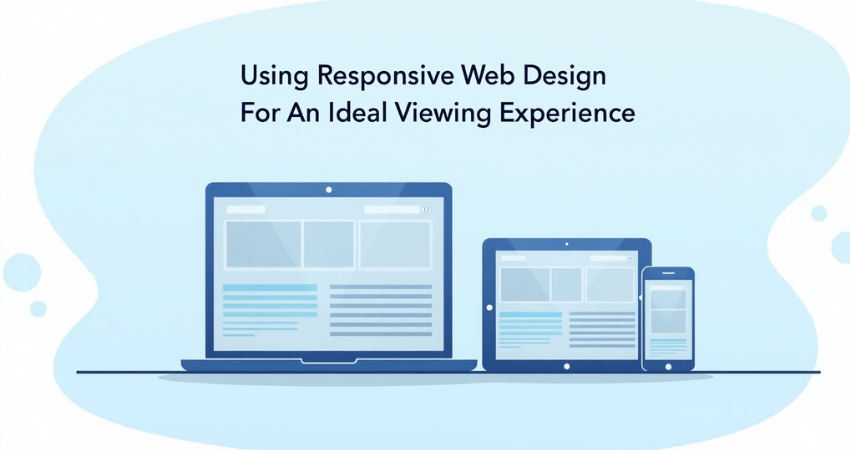
What is Responsive Web Design?
Responsive web design approach introduces a current method of creating websites that adjust automatically on any varying screen size and types of devices. The system layout would be such that when a user is accessing your site from a desktop, tablet, or smartphone, anything and everything will look as if it is functioning quite well on the device. It provides just great experience without pinching and zooming.
Not to downsize for the little screen, it comprises fluid grids and flexible images to attach to media queries for your body on purpose that it is accessible and looks good on all devices. The design should “feel right” on any view.
Responsive design is a little like water; it fits into whatever vessel it is put into. Responsiveness is the ability of a design to adopt itself to a digital device, which can also take the shape of responsive websites. This flexibility is what makes responsive design such a great tool in modern web development.
Users are nowadays accustomed to the phenomenon of websites doing just fine under their everyday fast-paced digital lives. Houses would leave a site within seconds if the site were hard to navigate or loaded slowly on their device. As such, responsive design is no longer an option but a necessity for any serious online presence creation.
People today are glued to their phones, which is the truth. Thus, the potential visitors or customers or leads accessed will be reduced significantly through neglecting mobile users. Responsive design is also efficient in that it saves building a separate site for different devices. One intelligent design works across the board which saves time, money, and effort.
Why Responsive Design Matters for User Experience
Responsive web design is not just a technological upgrade; it is really a breakthrough in user experience (UX). Certainly, if your site is able to adapt smoothly to any device, users are likely to keep visiting your site longer, engage better, and then come back again. So, in simple terms: At a coffee break somebody happened to visit your site on their mobile device. If the design is responsive: texts would be easy to read and buttons easy to tap and images would load quickly. Without fuss, they will get what they want. An unresponsive site would have a user struggling to zoom in, accidentally clicking wrong links, or waiting for things to load forever. That will be a guaranteed loss of one visitor.
A good responsive design site gives the users what they want without making them work for it. It keeps regards for their time and keeps them focused on your content, your services, or your products. When enjoying your site, people tend to trust your brand more. This would eventually lead to conversion; with conversion meaning signing up for newsletters, making purchases, or getting in touch with you.
Another thing to consider is that; Google is really serious when it comes to user experience. Responsive design brings with it goodwill in terms of the standings your site will have in search engines. Provided your site is mobile-friendly and very smooth to navigate, the chances are that it will rank higher in visitors’ search results.
And accessibility forms another part. Responsive layouts tend to lead to better design decisions for disabled users ensuring your website is accessible and usable by everyone.
In short, responsive web design makes visitors feel that your website is made for them specifically, even though, in a way, it is.
Mobile-First Approach in Responsive Design
Responsive web design is not just a technological upgrade; it is really a breakthrough in user experience (UX). Certainly, if your site is able to adapt smoothly to any device, users are likely to keep visiting your site longer, engage better, and then come back again. So, in simple terms: At a coffee break somebody happened to visit your site on their mobile device. If the design is responsive: texts would be easy to read and buttons easy to tap and images would load quickly. Without fuss, they will get what they want. An unresponsive site would have a user struggling to zoom in, accidentally clicking wrong links, or waiting for things to load forever. That will be a guaranteed loss of one visitor.
A good responsive design site gives the users what they want without making them work for it. It keeps regards for their time and keeps them focused on your content, your services, or your products. When enjoying your site, people tend to trust your brand more. This would eventually lead to conversion; with conversion meaning signing up for newsletters, making purchases, or getting in touch with you.
Another thing to consider is that; Google is really serious when it comes to user experience. Responsive design brings with it goodwill in terms of the standings your site will have in search engines. Provided your site is mobile-friendly and very smooth to navigate, the chances are that it will rank higher in visitors’ search results.
And accessibility forms another part. Responsive layouts tend to lead to better design decisions for disabled users ensuring your website is accessible and usable by everyone.
In short, responsive web design makes visitors feel that your website is made for them specifically, even though, in a way, it is.
Benefits of a Mobile-First Strategy
Indeed, adopting mobile-first strategies brings real and measurable benefits into the website and consequently the business. Most importantly, it helps reach your audience where they are-already mobile. Today, mobile traffic makes up more than half of total web traffic online and continue to grow.
By starting with a mobile-first approach, you will create an overall faster and more efficient experience. Pages load faster, navigation gets easier and information becomes simpler to consume. Overall, this sums up to happier users and lower bounce rates.
Another major benefit is better SEO. Google’s indexing is mobile-first, which implies that for the maximum part, it analyses your mobile site to determine how best to rank it. If your mobile site is properly optimized, therefore, your chances of ranking high increase. This drives free organic masses towards you without having to pay for advertisements.
Mobile-first also future proofs your site because new devices are coming out all the time-telephones, tablets, foldables, even smartwatches. When a website is designed on a principle of smaller screens first, that site conceptualizes adaptability future irrespective of whatever comes in.
From a business point of view, this increases the potential for increased conversions. If visitors can easily move around your site and achieve something—signing up or purchasing—there is less resistance to action. Mobile-first design eliminates the barriers that are typically present, even virtually, making them unrealized.
It’s not merely good looks in mobile, but it brings you better, faster, and more effective overall digital presence.
Common Challenges and How to Overcome Them
Responsive design is indeed powerful. However, there are several barriers to it. Most common is ensuring the design remains consistent across all screen sizes; things that look great on mobile sometimes don’t hold together well on a tablet or widescreen monitor.
Designers apply flexible grids and breakpoints to counter this scenario. It helps in layout smooth shifting rather than straining or squished. Testing on real devices also does a lot. Although simulators can help, nothing beats how your site behaves in someone’s actual hand.
And one challenge is performance, a responsive site could look great but be fat with images, unnecessary scripts, etc. Therefore, it slows everything down, especially on mobile networks. Compress images, lazy-load content, and clean code production can dramatically improve performance.
Navigation can be challenging as well; desktop menus do not translate neatly to mobile. Mobile-specific menus, such as hamburger menus and bottom nav bars, often win the battle, saving space while keeping the site easy to use.
Another important concern is the maintenance of the content hierarchy. A big screen may cause a mobile user to be overwhelmed. They have to think of the spacing, dimension of font sizes, and what appears above the fold very carefully.
And finally, responsive design will not always be easy when adding to an existing site. A new layout may, in some cases, be faster and cheaper than retrofit patching of the old one.
What is good? All these can be solved. One can always build an adaptive site that looks as good on every device as it is going to work with proper strategies, tools, and testings.
Conclusion
Responsive design is not merely a technical consideration but a promise of the best experience for the user by whatever means they are accessing the site. The process of creating a website that stands out from the rest and endures focuses on mobile first, performance, and common design impediments.
Whether you’re a business owner, designer, or just someone curious about how modern websites operate, to remain relevant in today’s digital world it’s important to familiarize yourself with responsive design. Not a fad, this lay at the core of how the web operates today.