
Introduction: Why Avoiding Mistakes in API Design Matters
In the present world where everything is interconnected, RESTful APIs constitute the bridge between client-side applications and back-end services. They empower the communication between web apps and mobile apps and even IoT devices. A clean and effective way of performing this interaction is offered by RESTful APIs and thus has become a part of most modern-day development workflows. However, designing a RESTful API isn’t simply mapping URLs with function calls. The architectural style may seem simplistic, but the intricacies involved in proper design—from status codes to security—are quite complicated. A wrong step in the design would mean an API that can hardly be maintained, is insecure, or is tough for other developers to comprehend and integrate with.
Trying to avoid the most common faults when designing RESTful APIs is highly critical. An API that is not well-designed leads the masses to confusion, breaks downstream systems, and may even result in compromised application security. Also, APIs tend to stay longer—any changes incompatible backward, deploys them to their external clients whose life becomes very much difficult. It means the initial design mistakes generally lead to long-lasting problems. Understanding which are common mistakes to avoid will lead to developing robust, scalable, time-tested, and maintainable APIs by developers. This article explores some of the most common mistakes in building RESTful APIs and ways to avoid them.
Misusing HTTP Methods and Status Codes
Treating All Requests as POST or GET
Most amateurs in RESTful API construction mistake all requests as either POST or GET without paying heed to why they were developed. The entire REST architectural style is constructed on the top of the HTTP itself and makes use of its methods-GEt, POST, PUT, PATCH, and DELETE-each having specific semantic meaning. GET, for example: must not be used for anything other than retrieval of data. POST is used usually for the creation of new resources; PUT and PATCH are used for the updating of already existing resources; and DELETE is for removing.
Unfortunately, the tendency in many implementations has been that developers misuse these verbs, making them default all read operations to GET and everything else to POST, updates and deletes included. This practice undermines the self-descriptive properties of RESTful services and makes it more difficult for clients to understand how to interact with your API. It can also lead to unintended side effects, such as caching issues. For example, a cache may end up wrongly caching a POST request, which results in inconsistent data. Following strictly HTTP method semantics improves the clarity and predictability of your API and allows for better optimizations by intermediary systems like proxies and caches.
Misunderstanding or Ignoring HTTP Status Codes
Another error that happens with regularity is the misuse or total lack of use of HTTP status codes. Many APIs send a 200 OK as the response, irrespective of whether the request has been a success, a failure caused by some client error, or a problem occurring on the server side, which is always a huge red flag for RESTful API design. This is what makes the correct use of status codes vital to building more trustworthy and user-friendly APIs. Each code represents an outcome of a specific request that the client must understand and react appropriately.
So consider the happy path of a 201 Created response when a new resource has been successfully created. This means the API informs the client that all went well and usually includes a Location header pointing to the created resource. A 400 Bad Request tells the client the responsibility rests with it; a 401 Unauthorized indicates trouble with the authentication. More specific, like 422 Unprocessable Entity, can speak even more. When these status codes are not being used appropriately, API consumers are basically left to figure out the results by parsing the response body, which is an inefficient and error-prone approach. Clear and correct status codes permit clients to create a much stronger and reactive application.
Ignoring Versioning and Breaking Changes
Not Including Versioning from the Start
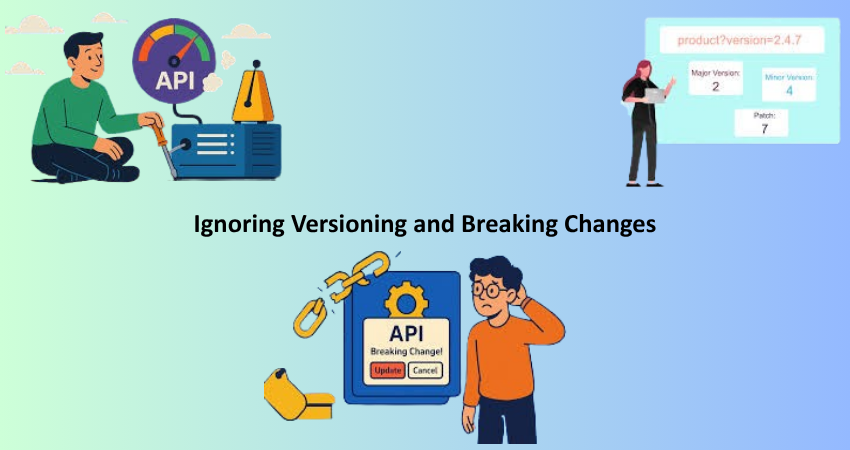
Normally, versioning is one of the most ignored aspects of a RESTful API, especially in the initial stages of development. Many developers assume versioning can be dealt with later on but soon find themselves feeling cornered when they are forced to make backward-incompatible changes. APIs, once consumed by external clients, become contractual interfaces. A no-warning change may break the whole integration model and jeopardize the trust of their users. Hence, implementation of versioning from Day One is very much a necessity, however irrelevant it may seem at present.
There are many ways to version an API. URI-based versioning (for example, /v1/resource), header-based versioning, and query parameter-based. URI-based versioning is generally the most obvious and well-accepted way to do it. Whatever the method, consistency and clear documentation must be adhered to. Versioning not only prepares your API to grow but also reassures your clients that their implementations will not break with an arbitrary change. It is better to version early and often than stay late and apply it under pressure.
Making Breaking Changes Without Deprecation
Equally troublesome is the practice of making breaking changes without providing a deprecation path. Owing to the fast-paced nature of software development, it is very tempting to make changes that require little to no consideration and thought-like fixes and improvements. The existing users of your API may find themselves dealing with broken applications or unexpected changes in behavior when there is neither a deprecation notice nor a defined migration path. This leads to frustration among users, less uptake, and ultimately a dent in your credibility.
A well-thought-out API will have a changelog, a deprecation policy, and some version lifecycle documentation. An example of this is that if an API endpoint is going to be removed or altered in the next release, its users should be notified beforehand, while they are also offered a version beside the present one for transition. Communication, of course, is key. In addition, letting deprecated functionality be known in the response headers or message is also an added benefit. Such transparency earns trust and gives your clients time to adapt their integration.
Poor Naming Conventions and Endpoint Design
Using Verbs Instead of Nouns in URLs
RESTful APIs’ endpoint URLs must only represent resources and not verbs that signify actions on said resource. One common anti-pattern in designing APIs is to literally use the verb in the URI path such as in /createUser or /deleteOrder and thus violate REST principles. The recommended way is to identify resources using nouns and to leave the expressing of actions to the HTTP methods. For example, instead of calling the API in /createUser, it should be /users with POST. Likewise, /orders/{id} with a DELETE request is preferred over /deleteOrder?id=123.
On the flip side, if nouns are used for endpoint paths, this adds benefits, such as making it intuitive and predictable for the API. Clients understand how to use those resources much better, which gives a better straight line for the documenting. Likewise, these RESTful approaches build a backbone that creates higher consistency between APIs and shortens the learning curve of any developer working on it. A seemingly minor point with this proper arrangement builds logical, extensible, and easy-to-consume APIs.
Inconsistent or Unintuitive Resource Naming
Inconsistent, ambiguous, or haphazard resource names unnecessarily create confusions and inefficiencies compounded with misuse of verbs. For example, some of the examples include changing from plural to singular forms, different casing styles, and using different non-standard abbreviations without explaining. Mixing /user, /Users, and /usr under an API introduce ambiguities that confuse developers and increase the risks of implementation errors.
Consistency: Pick a convention and stick to it, say plural nouns in lowercase with hyphens (for example, /users, /user-profiles). Don’t abbreviate unless it’s an immediately identifiable one. Again, think through hierarchical resources-one could have nested resources such as /users/{userId}/posts, which will better encode the relationship. A consistent, coherent nomenclature not only makes healthy improvements to your developer experience but also saves long-term maintenance and support overhead.
Neglecting Security Best Practices

Failing to Authenticate and Authorize Properly
Many RESTful APIs really fall short in the regard of security. Often, that’d be considered entirely putting their trust on client-side controls or an outdated method of authentication. With no proper proper authentication in place, anyone can access your API, resulting in a breach of data and unauthorized actions. While not effective enough, authorization grounds that assume the authenticated user to fully access everything within the context will lead to tremendous access control problems.
Modernly built APIs usually have a strong authentication mechanism such as OAuth 2.0, API Key or JWT (JSON Web Tokens) for which they may considered depending on the use case; these should also include server side validation of tokens with endpoint restriction by roles and permissions. Multi-tenancy architectures should affect access isolation so that they don’t mingle with the information of other user accounts. This alone jeopardizes both the data of the user and the integrity of the system altogether. Programming your API not to contain sensitive data today does not absolve it from being secured at the backend from the start.
Exposing Sensitive Data in Responses
Another serious security hole includes accidentally leaking sensitive data through API responses. It might be anything from user passwords to internal identifiers to configuration settings or even debug information in error messages. This really happens unintentionally due to lack of data filtering Or Ower Logging. But attackers can use such information leaks for reconnaissance, brute-force attacks, or privilege escalation attempts.
Sanitizing your output is the best way to prevent the above risks from affecting you. Leave the sensitive fields out in response payloads unless it is explicitly required to include them. Implement role-based views to restrict the information that is disclosed to users based on data access privileges. In any case, be careful with your error messages; return only that information that is useful for identifying the problem, while never exposing stack traces or internal logic. Continuous security audits, automated testing, and code reviews should be a formal process for recognizing and eliminating such vulnerabilities before they hit production.
Conclusion: Building Better APIs Starts with Avoiding Common Pitfalls
An intuitive, maintainable, and secure RESTful API is hard to come by; however, avoidance of the common pitfalls can make these things come by easier. Issues from misuse of HTTP methods and proper status codes ignoring to neglecting versioning and security are usually symptoms of hurried planning and design processes. Each of these mistakes might look very small in itself, but the accumulation means a lot when it comes to reliability and usability of your API. Even understanding and applying best practices is all about given those developers relying on your interface a good time.
With RESTful APIs powering digital experiences across the web, mobile, and cloud, nailing the fundamentals must be of utmost importance. Whether you are a junior developer or a senior architect, this mindful yet standard approach toward API design will always be profiting. Documentation must be crystal clear with all changes, while developer experience must be a priority. If you will avoid these vital errors, the APIs designed will gain trust and scalability and shine for long-term success.