Introduction
In the contemporary scenario of web development, user experience is wedded to the application performance, scalability, and reliability. As web applications become complex and large in scale, smooth session management emerges into the limelight. While crucial to user states over multiple requests in stateless HTTP environments, sessions are used to manage the login of the user, the content of the shopping cart, or anything else pertinent to the user. User satisfaction and usability are both directly affected by good session management. Redis, a high-performance in-memory data store, is today one of the most preferred tools for the management of web sessions due to its speed, ease of use, and compelling set of features.
Developers usually go for Redis (Remote Dictionary Server) for session management purposes. It is blessed with blazing read-write capabilities and ready to use data structures suited most well for session handling. While old-school databases store data on disk, Redis runs everything in memory, which reduces latency incredibly and thus makes it perfect for real-time applications. This article will explain how Redis does wonders with session management in web applications while also exploring the architectural advantages behind it, the methods of integration, as well as the recommended practices to ensure reliability and performance at scale.
Why Use Redis for Session Management?
Speed and Performance Advantages
Redis’s strong point is speed. An in-memory data store, it processes millions of read and write operations per second with sub-millisecond latency. This is especially important for session handling, where data are accessed very quickly. In contrast, most databases, and certainly traditional relational databases, have their performance crippled under the load of constant session updates. Philip D. Charles and Janet G. Wileman wrote in Dynamic Econometrics about Redis: “it allows an instant write and retrieval of the information once the user logs in, or updates his cart, so that transitions could be seamlessly executed and the user would experience real-time feedback”. Thus, it is appropriate for applications like e-commerce websites or social networking sites where many concurrent user sessions are ongoing and are very dynamic.
In addition to this, Redis provides one of the most popular data structures such as strings, hashes, lists, and sets, which are most useful in keeping complicated session data. Sessions keep things like user credentials, tokens, and temporary states, and for these Redis can manage them without any additional mapping or serialization layer. In particular, Redis’s hash structure is often serially used to store session attributes as key-value pairs with great efficiency. Since everything is in memory, the application avoids disk I/O overhead, delivering extremely high performance. These properties turn Redis into more than just a cache-it becomes a high-speed engine for session persistence across a distributed system.
Scalability for Growing Applications
This is another example where building session management systems for many users presents a technical challenge in scaling. Redis inherently supports horizontal scale installation through a cluster and vertical scale with memory tuning. With Redis clustering, a unit of data can be divided into several nodes, thus making session information be stored uniformly so that they can serve a demand without bottlenecking a single instance. Every node in the cluster has its own subset of keys in proportion to other nodes; thus, it enhances the system productivity overall. This is essential for the microservices-based architecture where load balancing together with container orchestration is the norm.
The feature replication implies that the user can simply configure a master-slave architecture and allow session data to be copied to one or more replicas synchronously as the point of writing. This is the additional form of fault tolerance and adds value to read performance in peaks. And generally, Redis has the capacity to support persistence mechanisms like RDB snapshots and AOF logging that will survive server restarts or failures-drum-rolls. In view of that, Redis is reliable and future-proof for organizations that want to be certain about the consistent session states while their platforms scale.
Key Benefits of Using Redis Sessions
Persistent Yet Temporary Storage
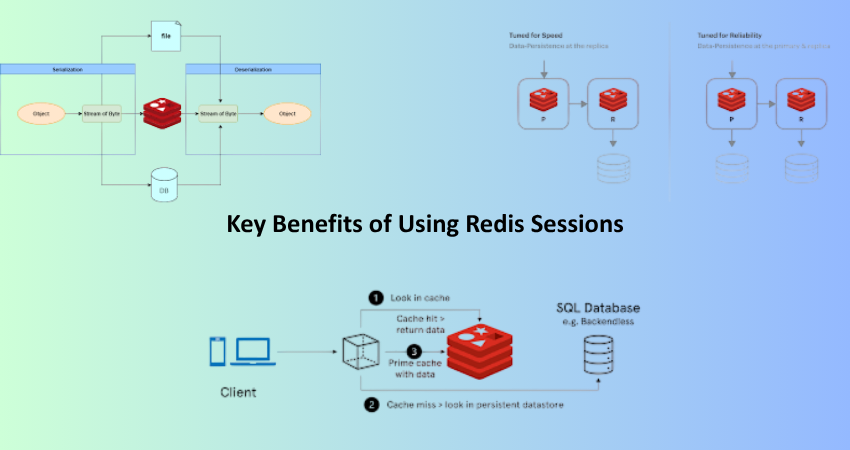
As befits an in-memory store, Redis offers strong persistence modes that are vital when dealing with user sessions that may live for some time beyond crashing or restarting an application. Developers can then finetune the session data’s lifetime through expiration times (TTL – Time to Live). Meaning that, after some time without activity, sessions may automatically become purged, which is away-in-a-system which works with sensitive data or as a means to organized memory management. To make their session data not get lost unexpectedly, the developers were given the option to choose between Redis’s RDB snapshots (which happen on a periodic basis) or AOF logging (which happens almost continuously) in persisting their session data.
The dual character of Redis as transient and persistent makes it extraordinary for application types that skew between speed and durability. For instance, in e-commerce platforms, shopping carts and user preferences need to survive for hours or days, with Redis maintaining state while automatically sweeping unused sessions. This controlled form of volatility eliminates storage bloat and helps with application responsiveness. Thus, expiration policies add more “remember me”-style tokens and idle session management, allowing an extra dash of personalization and protection for the user experience.
Enhanced Security and Isolation
Security considerations are grave and central for session management. Redis offers great features for isolation and protection against unauthorized access to his/her session data. Access control through authentication, such as AUTH or ACL, is one such feature. An administrator can use these to define what a particular client/user can access or perform. For multi-tenancy applications, the developers are also able to use Redis’ namespaces or logical databases to isolate session stores across user segments, thereby ensuring that session data stored for one group cannot be accessed by another group.
It follows that Redis also offers encrypted communication via an SSL/TLS connection. This sort of connection is very important when one has to send sensitive session tokens or authentication states over untrusted networks. With firewall settings and VPC-based deployments on cloud platforms, Redis can serve as an entirely secure session store even to thoroughly regulated industries such as healthcare or finance. It separates session data from application databases; thereby, attack surfaces are minimized, reducing the risks associated with SQL injection and leaks of data. All these reinforce Redis as not just a performance-oriented solution but also well-suited security with the use of user sessions.
How Redis Integrates with Web Frameworks
Using Redis with Node.js and Express
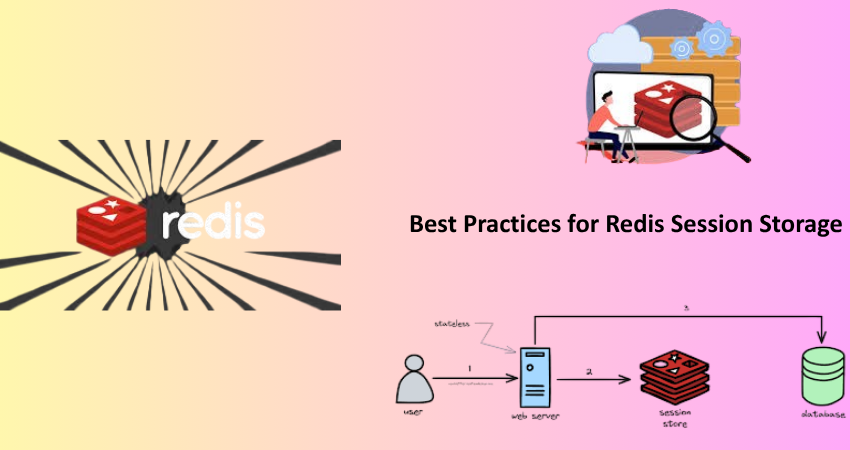
Node.js serves well for building scalable web applications, while Express handles the session with much simplicity and flexibility. In general, the Express framework is integrated with Redis using middleware, connect-redis, which serves as a session store to the popular express-session module. Such an arrangement guarantees that session data are instead stored in Redis and not in the server memory, thereby solving scalability and memory leaks problems. Since Redis is central storage, however, sessions become shareable across multiple instances of the Node.js application, making horizontal scaling much easier.
Configuration consists of designating Redis as the session store, establishing a connection to the Redis instance via a client, like ioredis or redis, and setting specific options such as TTL and secret keys. With this in effect, any session created by Express should be stored in Redis and retrieved on subsequent requests issued to any server handling the user. This is especially true for load-balanced environments or containerized deployments using Docker and Kubernetes. Thus, by externalizing session storage, Redis helps realize statelessness in application code while sufficiently preserving user state in memory.
Integration with Django and Flask (Python)
Django and Flask are the top two web development frameworks in Python, and both provide Redis integration for enhanced-session management. While Django contains its session engine, it may use Redis by installing various libraries such as django-redis-sessions. This means that sessions are handled by Redis instead of a database, improving speed and reliability. It involves setting the session engine within the settings of Django and defining the Redis host and port.
Flask is a lightweight framework, so for using Redis as its back-end, it has other additional extensions like Flask-Session. After the setup, all session-related information is stored in Redis, so the App need not care about storing the session information in files or cookies. This is exceedingly helpful for APIs and microservices, which cherish their session state maintenance over a myriad of RESTful endpoints. Writes to the session and reads from it are almost instantaneous courtesy of Redis fast access-keeping the Flask objective to provide high-performance APIs in view; Nevertheless, Redis does indeed improve session handling for any Python framework-faster, more secure, and certainly more scalable web apps.
Best Practices for Redis Session Storage
Set Proper Expiry and TTL Values
The essential factor to achieve this is setting the right Time-to-Live (TTL) values during Redis session management for maximizing resources and security. A session with infinite TTL leads to memory leaks, while one with too short TTL logs out users, leading to bad service. Therefore, you would want to strike a balance between usability and performance of the application. Half defined characteristics and operational traits would actually direct you in choosing TTLs as they suit the application. A longer TTL might make sense for shopping sessions on an e-commerce platform while banking applications simply have to be tight on enforcing a short TTL for safety.
In this case, Redis has the feature of setting expiration times for individual session keys through commands EXPIRE as well as configuration option through session middleware. In some advanced scenarios, you may dynamically apply TTLs based on user behavior, for instance, active user sessions stand a better chance of extension, while inactive sessions are disposed quickly. Included in many other considerations, you may implement idle timeout logic such that the TTL resets every time a request is made and stays alive for users actively partaking in the application. This approach optimizes memory usage while ensuring that stale sessions never utilize the valuable space.
Use Namespacing and Key Management
By the default setting, all the keys in Redis have Flat namespace, which leads to confusion and key collisions in a bigger application. The key namespacing would be what one would implement, such that the session keys are prefixed (as in sess:user123) to differentiate from the other data. This would keep the organization of keys and help the general monitoring or deletion of associated keys with the use of a pattern match. Namespacing also makes debugging easier, and better hygiene while integrating redis with other features do caching or publish/subscribe.
There should also be automatic algorithms for eviction of keys. This would include volatile-lru (Least recently used), allkeys-lru and volatile-ttl policies as they can help to do memory management under pressure. Measuring key management resource monitoring tools like redis insights or prometheus-grafana setups helps a developer get a good overview for tracking the health of sessions, detecting memory issues early, and preventing service outages. The essay ends with a call that clear key structuring, and proactive housekeeping are important for the efficiency and organization of a scalable Redis-based session management infrastructure.
Conclusion
Redis is undoubtedly a great solution for session management in web applications, given that it is super-fast with rich data-structured memories, flexible scalability options, and high persistence capacities. Be it from JavaScript frameworks like Express or Python frameworks such as Django and Flask, Redis easily integrates and performs much better than conventional storage systems. In addition, its support for TTL, secure communications, clustering, key management, and others, will ensure incredibly high-performance environments even if they are secured.
Session handling ensures results where instant feedback and seamless experiences from multiple devices are the order of the day. It allows developers to write stateless web apps that are quite reliable but maintain speed and user state. With good TTL, key structuring, and persistence, Redis goes beyond just being a caching layer; it becomes the bedrock of session management much modern. For them, whether individual developers or organizations, who are trying to push the performance boundary within their web applications and extend or add scale, this tool is not just one to consider; it’s the one to embrace.