
Introduction
REST API’s are essentially part of modern software development, where different systems communicate with each other. Software continues to improve and, in course, API too gets improved or changed-sometimes even in a drastic way. Changes in APIs can occur and may affect existing users or integrated and third-party applications. This is where the concept of API versioning becomes important. API versioning means that new changes do not affect existing client applications by providing different “versions” of that API which users can choose from. That is why it is important for all developers-whether novice or expert-to understand REST API versioning and how it can help ensure sustainability for applications.
It can give an impression of an intricate concept when in fact it is a manageable way of throwing change without havoc—versioning. It could be something wherein a developer manages which version of the API that is used, and, therefore, their applications continue working probably as the underlying system evolves. Otherwise, every little tweak would break, bug, or interrupt workflow or services. This article will start from the ABC’s of REST API versioning: why it’s important, what strategies to use, common ways to implement it, how to plan for the future, and what tools and documentation can back up the crucial effort of creating it.
Why Versioning Matters in REST APIs
Maintaining Compatibility Over Time
One fundamental reason why API versioning is practiced is to protect the compatibility of current users while changes are made to improve or extend the API. In any given development lifecycle, an API is not a static entity. It evolves, changes, and gets better in terms of user needs, performance capabilities, and technology changes. Once any changes are introduced, such as adding new endpoints, removing deprecated features, or altering response formats, client applications that expect the old behavior might just stop working entirely. Hence API versioning essentially becomes a safety mechanism that prevents API changes from disturbing users who are still on older versions. This guarantees that even the skeletons of legacy systems or applications can continue to run trouble-free while new features are being introduced into a more modern API version.
Versioning is not optional in real life but is mandatory. An example is an e-commerce platform powering thousands of online stores through its APIs. If a new API update omits certain fields, or changes their associated structures, all dependent integrations fail leaving behind unnecessary downtime, customer complaints, and loss of revenue. Versioning has helped promote the co-existence of various versions of an API, saving the older clients using stable, known interfaces and allowing newer clients to benefit from the latest improvements that release would have to offer. It is a win-win deal to keep faith and reduce risks and benefits to be had for the overall developer experience.
Supporting Evolution and Innovation
Another important reason for versioning is that it allows innovation carried without fear of a backward compatibility break. Technology is fast-moving; new requirements arise, better performance techniques are developed, and the developers want to add even more value to their APIs. This cannot be done well while always worrying about never breaking the current ecosystem. Versioning is an orderly means of moving forward that separates any experimental or cutting-edge changes into a subsequent version while maintaining stability in the older ones for users who are not quite prepared to transition yet. This clear demarcation of change allows the developers to go ahead and innovate while the service remains reliable for everyone else.
In the above context, code architecture being designed with versioning really helps in keeping things clean. API becomes the place for added conditional logic to crudely resolve what really are obsolete needs of clients if versioning is not done down the road. This adds to maintenance efforts, raises the probability of bug introduction, and distracts from overall API reliability. On the other hand, versioning allows compartmentalization of change; thereby, old versions can be gracefully phased out when usage goes down, keeping new versions efficient and lean. This offers enhancement to maintainability and a maximally scalable API ecosystem, promoting consistent development while keeping stability uncompromised.
Types of Versioning in REST APIs
URI Path Versioning
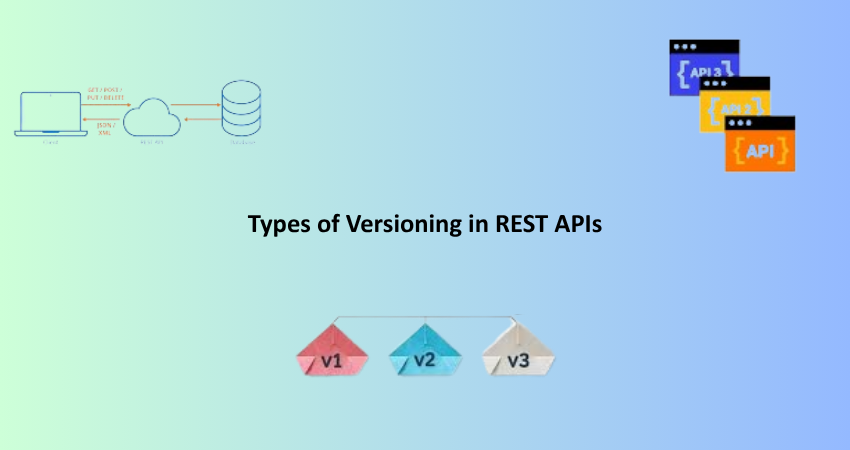
The URI Path Versioning can be called one of the most visible and beginner-friendly versions concerning REST APIs. It means specifying the version number directly in the URL path, such as /api/v1/resource. This method is one that can be clear to both clients and the server-side developers. Thus it serves the purpose of distinguishing between different API versions for the two sides. Routing logic has no trouble supporting this method, allowing the definition of separate endpoints or controllers for each version. In turn, this will aid testing and debugging, especially in complex applications. With URI path versioning, older versions could be said to run with the newest version without conflict; thus, it is a user-friendly mechanism for handling versioning.
Of course, this method has some disadvantages too. Common practices have put some form of an interface version in the URL, but this usually makes for increased maintenance effort-lifting hands towards consistency across similar endpoints and oftentimes duplication of business logic across versions. It does not, moreover, come very close to the so-proclaimed RESTful methods that discourage placing version information in the URI–locations of resources are valid for some predetermined time. Nevertheless, there is much appeal in its easy implementation to most API designers facing clarity alongside separation over RESTful purity.
Query Parameter and Header Versioning
Another common approach is versioning via query parameters or HTTP headers, which keeps the URL clean and REST-compliant.” Through versioning with query parameters, clients refer to the required version by adding it as a parameter to the request URL, e.g. /api/resource?version=1 . This method will give flexibility while handling the versioning without modifying the endpoint path. Moreover, this would be easier while applying version logic to the controller level and making the URLs consistent across the different versions and documentation states that query parameter versioning is particularly useful for internal APIs wherein flexibility is usually required more than obligation toward conventions.
This is very much considered to be the RESTful programming as this method will not speak/version up the URI. It will not remain the definition of the client, but the version will be sent to its custom header (e.g., Accept-Version: v2). This leads to pure, resource-based URLs and a complete separation between the definition of the API and logic of versioning. It’s best for the corporate environment or APIs that are going to be locked down and highly compliance-driven. It does raise the bar from the beginning, given that you have to understand HTTP protocols further and also configure your clients more sophisticatedly. But we did find this method clean and scalable for header-based versioning with well-documented, stable APIs.
Implementing REST API Versioning
Designing for Scalability
Versioning is not only about strategizing; it is also about making provisions for scalability and change in time. An API is designed for versioning only if the developers carrying out the design think ahead about existing functionality before any future updates are made. Decoupling business logic for modular code-oriented development and middleware that can route much versioning would be some ways to achieve this. For instance, in applications like Express.js or Django, the routing layers would be abstracted to point to different controllers based on version input. The basic and shared business logic is well defined and reusable and each version of the API works independently when required.
Scalability is completely dependent on database versioning and backward compatible schema changes. After a new version has been released, it is up to the developers to consider whether the underlying data model must also be updated. If yes, a well-considered migration strategy must be applied so that data will not be corrupted or services interrupted. Tools such as Liquibase or Flyway can smooth these transitions. Furthermore, every version should be tested in the CI/CD pipeline such that regressions don’t slip in. That’s how these practices will ensure REST API versioning never becomes a bottleneck for innovation but rather an enabler for sustained growth.
Handling Deprecation Gracefully
Version lifecycle management is a key aspect of versioning. Eventually older versions are no longer useful and are better off being phased out to minimize the maintenance burden. This has to be done judiciously so as not to annoy users or break integrations. It is good practice to announce deprecations as early as possible: from six months to one year prior to full removal. Deprecation can be communicated by API providers via response headers (e.g., Deprecation: true), along with transition materials such as upgrade guides or change logs to assist clients in the transition. Being transparent builds credibility and provides the clients with confidence for long-term support of the API.
The good graceful deprecation entails reviewing usage statistics and determining what versions are still in full force and can be phased out safely. Logging tools such as New Relic, Sentry, or even a little customized analytics dashboard give interesting pointer on how each version is being consumed. For enterprise-grade APIs, automated email alerts or dashboard banners can notify developers when they are using expired versions. Sometimes, an incentive such as featuring a speed boost or a new feature entices users to migrate. So versioning is much more than a technical process; this is about communicating and supporting the establishment of a stable, evolving, and trusted API ecosystem.
Tools and Documentation Support
Leveraging the Right Tools
The choice of tools and platforms makes a great deal of difference in versioning puzzles. For example, they provide an interface for every version in the life cycle of design, testing, and deployment- the names of such applications being Swagger (OpenAPI), Postman, and Stoplight. For instance, Swagger allows the developers to write contracts of version in the YAML or JSON format and defined very clear contracts for each of the API versions. Hence, it is possible to perform automatic validation of the contract within CI/CD workflows. Similar to that, Postman also allows the use of collections to allow versioning that enables testing of a particular API version without affecting the environment of production. As a whole, these tools reduce the chances of version drift between deployments while ensuring consistency in behavior.
API gateways such as Kong, AWS API Gateway, and Apigee are yet another excellent collection of tools. They make version routing, load balancing, and allocation of rate limits per version much easier. Built-in analytics and monitoring dashboards help detect patterns in usage and show symptoms of problems early on. Automated change detection and rollback options make these an even more powerful offering for the management of enterprise-grade API. By integrating them into the lifecycle of the API, developers can ensure that versioning will be orderly, maintainable, and resilient all the way through the maturing process of the API.
Writing Effective Documentation
Good documentation is essential to API versioning done well. Each version of your REST API should have its own documentation page, detailing exactly what the version does, what has changed, and what are its limitations. This helps developers to integrate faster and avoid numerous support requests and errors. Dynamic document hosting platforms such as ReadMe, Redoc, and GitBook will allow you to provide version-specific tabs or filters to maintain organization and enable your developers to compare the versions side-by-side. The documentation will include endpoint descriptions, request and response formats, status codes, error messages, and rate limits, among others.
Likewise, migration guidelines play a very important role in easing the transition of clients from one version to another. Such guides should carry information regarding breaking changes, deprecated endpoints, any new parameters in the API and examples for migrating client code. It can also include visual diff tools to highlight what has changed from one version to another. Well-structured change logs as well as version histories would, as well, enable developers to trace the evolution of the API along with all the intelligent, logical reasons for the high-end updates occurred. Thus, it tends to invest more in very detailed and clear documentation as well as credible source, thus enhancing the experience with the developer and, therefore, a better adoption and less integration issues.
Conclusion
When a software program undergoes change at an extremely quick pace, software engineering and product managing life, the essential concepts of API versioning are observed for the best kind of compliance, with visibility for innovations and then to support an entirely scaled software design. The matters regarding the why of versioning, and the ways of achieving it were remarkably introduced, hence the application developers are not just obliged to do it; instead, they must be subject to it. The success techologically issues become less daunting since the presence of a versioning model, but on the contrary, a modeling framework gets abandoned with managers largely satisfied, neglecting the more critical matters: upgrading mechanisms; keeping an eye out for resources; does the environment fit mechanism perfectly; and finally something should be done on upgrading by the developer community.
When APIs are concerned, change becomes synonymous with necessity. What separates a maintained API from a breakable one is strategies on how it can evolve. Versioning of REST API is an internal way for teams to adapt and cater universe with due respect, to grow their platforms knowingly. The power of versioning should be available to the development team, alongside elevated exploitation levels. Any development team, with idea, proper tools, and communication strategies, has a chance to have truly solid APIs.