
Introduction
Well, frankly, keeping the data and managing the access on resources in the present fast-changing times of web applications and software services is more critical than ever. Application Programming Interfaces are also renowned as the bloodlines carrying the message from one software platform to another and connecting with one another for sharing. While these make it possible for using the very well communication between systems at the same time, there also comes the responsibility of fetching and manipulation of the data through APIs that should be computer secured. One of the most effective ways would be Role-Based Access Control, or simply RBAC. It is organized manageable permissions so that only the right people get access to certain actions from specified data within an API.
Cyber threats and data breaches have become a rising concern, prompting developers and architects of security to rethink their access control strategy. There are several ways to manage a user’s permission; however, RBAC stands out for its simplicity, scalability, and reflection of the organizational structure. Unlike discretionary or mandatory access controls, RBAC ties access rights directly to user roles within an organization, making it easier to audit and maintain over time. This article will discuss the reasons RBAC plays a critical role in API security, the advantages it brings, and how it can be rightly implemented to reduce possible security threats.
Understanding Role-Based Access Control (RBAC)
What is RBAC and How Does It Work?
The Role-Based Access Control (RBAC) is actually a model of that security rule by which the access of the system is made possible according to the roles of each individual within an organization. Instead of assigning direct permissions to each user, permissions are assigned to roles, and all the responsibilities or job functions for which a user will be associated within that organization will determine the role these permissions will represent. This signifies that in case of any future change in the job of a particular user, it only takes the administrator of the system to change the user’s role, and thus the subsequent permissions will be automatically be updated. This makes the management of user permissions centralized and logical in nature, and makes it more effective and less conducive for errors.
RBAC comprises three basic elements: roles, permissions and users. A role is a collection of permissions that are associated with some actions on resources rather than an action on a resource itself. Permissions allow defining the type of access granted such as reading, writing, and deleting data. Users are assigned to roles and so, resource access is decided by the permissions of those roles. This particular RBAC architecture can be specially applied to large organizations where hundreds or thousands of users require access to API security, aiding in security and compliance with responsibility.
Key Components of RBAC in API Security
While implementing RBAC in API security, a clear definition of the roles and permissions and their relationships with various design and functional endpoints or resource data must be established. For example, the API may have a customer data management endpoint available, along with one for operations on financial records as well as internal workflows. These are diverse types of endpoints requiring diverse access levels that might be catered for by RBAC with specific permissions mapped to these roles: “Administrator,” “Manager,” and “Employee.”
In an ideal world, to bolster security further, RBAC should sit on top of the authentication and authorization mechanisms of the API. Thus, when an API endpoint is called, what happens is that firstly the identity of the caller gets authenticated and checked. Thereafter, the user’s role is checked, followed by either granting or denying the user the access to perform the action requested according to his role. Such an approach guarantees that sensitive data is only available to those users who have been assigned the proper roles, dramatically diminishing any risks in unauthorized access or data leaking. Hence, with these building blocks, RBAC stages more security for the APIs while keeping a clean and manageable scheme for access control.
Why APIs Are Vulnerable Without RBAC

Common Security Risks in API Access Control
The APIs are, by far, the primary spots targeted by online criminals since they provide direct access to application data and services. This implies that in the absence of proper access control mechanisms, such as role-based access control, an API can be targeted with many security threats such as unauthorized access, data leakage, privilege escalation, and denial of service. When permissions are assigned directly to individual users without a structured system, it becomes difficult to maintain a secure environment. Mistakes or inadvertent errors lead to a scenario where excess privileges are granted and pose a very serious threat of exposing sensitive information and exposing the attack surface even further.
Without RBAC, access management turns into an error-prone manual process. Developers tend to hard-code the access rules, resort to insecure token sharing, or write tangled code to check user permissions. These approaches increase maintenance overhead and, thus, create their own weak surface for possible attacks. In addition, there is no RBAC, and it will be nearly impossible to understand who has access to which resources and why. As such, the recorded lack of transparency would make it almost impossible to carry out even reasonably effective audits or compliance with data protection laws like GDPR or HIPAA.
The Consequences of Inadequate Access Controls
Organizations hike up the danger with the failure to implement robust access control policies like RBAC. Breaches of data caused by unauthorized API access cost financial penalties and legal damages, besides damaging the goodwill of an organization in society. In some scenarios, customer data exposure due to poor API security leads to regulatory fines and loss of consumer confidence. Poor access control can even lead an employee-the greatest enemy in any organization-to misuse access completely unintentionally or otherwise to data not meant for their eyes.
Operational inefficiencies can also exhibit the absence of RBAC among companies. Poorly defined roles bring about logistical nightmares when onboarding and offboarding. A user joining or leaving the team would require an administrator to tinker with the permissions manually, and errors or delays are bound to happen now and then. In contrast, role assignments that automatically adapt a user’s access levels can be done through very quick and efficient means without much fuss. Basically, not having RBAC exposes organizations to unnecessary security risks and operational burdens that would otherwise be easily avoided using access control strategy.
Benefits of RBAC for API Security
Enhanced Security Through Least Privilege Principle
The principle of least privilege is probably one of the primary security principles which may benefit from RBAC. According to this principle, users must be granted only the minimum level of access required to perform their job tasks. Assigning permissions to roles instead of individual accounts means that under RBAC, a user as such cannot perform any unauthorized action that lies beyond his assigned responsibilities. This serves to reduce the risk of unintentional or intentional manipulation of data, thereby hardening the API against a given threat.
Simple RBAC security models can also be utilized to enforce security policies on multiple endpoints. Defining roles with tightly controlled permissions facilitates auditing and monitoring access patterns. In addition, API gateways and security middlewares can be set up to validate such roles and permissions for permitting sensitive operations. Therefore, this raises a threshold for data exposure and helps maintain compliance with regulations. On one hand, RBAC is justified by an application of the least privilege, while on the other hand, it encourages a security-first approach consistent with modern API development best practices.
Simplified Permission Management and Auditing
Contrary to RBAC, which is accessing permissions assigned automatically, hence complicating them is included in API systems without much hassle like when a new user is mustered under one of the predefined roles and there would be no need to configure access rights for each. Such improvements can enhance the onboarding period with regard to uniformity in accessing control policies. Similarly, when a user moves on to some other function, or in case the user leaves the organization, access is given or stopped very easily and naturally through role assignments.
RBAC represents a wonderful and meaningful appeal to auditors in terms of tracking user activity and corresponding access levels. The logs may be filtered with an additional focus on roles, thus testing for anomalies or possible security incidents. Auditors and compliance officers would then go and review access records in accordance with organizational policy and regulations. This amount of visibility is crucial for maintaining accountability and able to prove compliance during the audit. Thus, RBAC will ease the administrative burden and more importantly, in the oversight functions that concern API security management.
Implementing RBAC in Your API
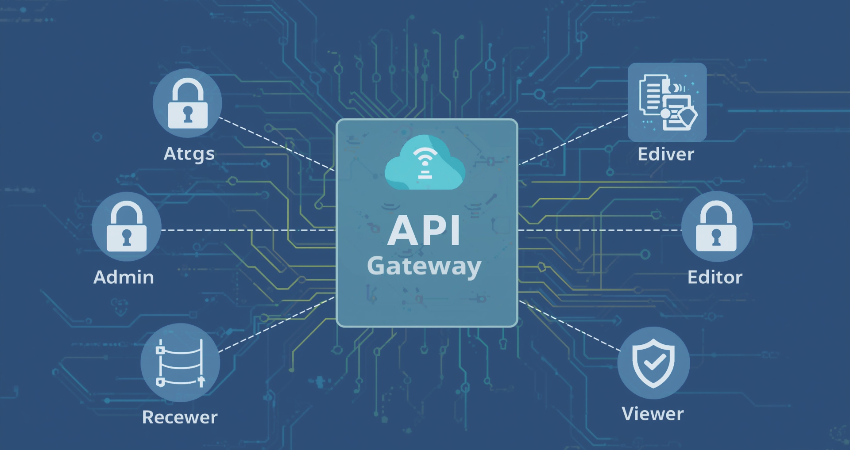
Designing Roles and Permissions Effectively
Successful design determines roles and permissions that actually mean something to your organization. Start with the identification of user types who interact with your API-some administrators, developers, analysts, or external clients. For each user type, describe actions required to perform and the data they need access to, and then group those permissions together to create roles that reflect job functions in the real world avoiding any impositions where roles are granted unnecessary functions.
On the contrary, avoid the explosion of roles where too many narrowly defined roles are created that make them hard to manage. You need a balance between granularity and simplicity. Apply a permission matrix to map those roles to the actions allowed, and document these well. Periodically revisit your roles so that they may become really relevant as your API matures. Thoughtful, deliberate role design is an essential stepping stone toward effective RBAC implementation.
Integrating RBAC with API Authentication and Authorization
Now the next step is the implementation of the RBAC on the authentication modules along with authorization implementations of the API after defining all the roles and permissions. This is usually done via JSON Web Tokens (JWT) or OAuth 2.0 tokens, holding the role information in the payload of the token. When a user logs on or gets a token, their role gets embedded in that token, and upon that, the API uses middleware to check the token, fetch the role, and find whether the requested action can be executed.
Like most other modern API frameworks, there are various in-built or simply plug-in ways to use RBAC in it. For instance, in Node.js, you can rely on some middleware libraries to set role-based permissions before reaching an endpoint in your logic. In the same way, other frameworks such as Django or Spring Boot offer route guards using decorators or annotations to define access in terms of roles. Also, it is a good practice to keep the central logic of RBAC for consistency throughout the API and to eliminate chances of misconfiguration. Tight integration of RBAC into the access control layers of the API ensures a robust and scalable security model.
Conclusion
It is an access-control mechanism that enhances control and security at an organizational level, a phased model for security strategy, rather than just a technical feature, has designed an institutional scale on securing and efficiently managing API access. Permissions tied to user roles thus allow for approved individuals to perform sensitive operations, reducing risks such as data breach, privilege misuse, and compliance violations. Whether it be an internal small API or that of thousands accessing a large-scale service, RBAC represents a key step in achieving access control and strong long-term security.
While APIs are being targeted increasingly by attackers in today’s threat environment, merely relying on ad hoc permission schemes would not suffice. RBAC offers a structured approach that not only relieves but also simplifies the management of permissions, supports the principle of least privilege, and enhances visibility into user access for a fast and consistent response to any changes in user roles while having a unified security policy. It thus becomes apparent that it is though best practice to adopt RBAC for API access control, essential, perhaps even more so, for the protection of data, users, and reputation today.